Tuesday, July 31, 2012

The Seagram On Park

The Seagram building, at 375 Park Avenue and 53rd Street, is one of my favorite buildings in all of Manhattan. It's one of the few sky scrapers with a plaza in it front of it. It was designed by Mies van der Rohe and built in 1958.

The Seagram Building's plaza at 375 Park Avenue

Made of bronze and glass, it's like a modern sculpture in the sky. The beauty of the building is the plaza in front of it. It acts as a platform or a pedestal of sorts, giving the piece (the sky scraper) room to be viewed. When you look through the lobby from the outside you can see right through to the back of building, giving it a light, floating feeling. The additional office space needed was built behind the main building--a smaller building on 53rd Street, home of what used to be the famous Brasserie restaurant where I used to go as a kid, and is now The Four Seasons restaurant.

Mies van der Rohe, who emigrated to the United States from Germany in 1937, was such a genius. So much so that many architects designing Manhattan office buildings took from the original Mies design--minimal modern glass and metal.


Tuesday, July 24, 2012

Bertoia on Fifth Avenue


Today, Blaise took photos of two Harry Bertoia sculptures--a massive screen and a large cloud hanging from the ceiling--featured in the phenomenally restored Manufacturer's Hanover building. The space at 510 Fifth Avenue at 43rd street, once a bank, is now home to the Canadian clothing store Joe Fresh.


Both sculptures were removed from the interior and had to be restored and re-installed in the original positions. I like the way the clothing store worked with the sculptures to feature them prominently as a major part of their decor. Originally, the Bertoia screen divided public banking from the private banking. Now it acts as the entire back wall of the bright, sprawling second floor.

NBC New York writes:
Dubbed "an architectural gem" by creative director Joe Mimran, the glass-walled building was designed in 1952 by Gordon Bunshaft (best known for the Hirshhorn Museum in Washington, DC), and was made an official landmark in 1997. 
Beautiful though the building may be, massive restorations were required to prime the structure for Joe Fresh's arrival, including the re-installation of a winding, 70-foot screen by sculptor Harry Bertoia, which can be seen on the second floor.
It's so great. Going there feels like you have a private art viewing in a public space.


Monday, July 23, 2012

Four Visionaries Pioneer Teacher's Village

Every time I write on this blog I look at my assistant, Blaise, who is a real writer, and I say to her, "I hate this. It's such a struggle for me to write." Another friend of mine, Lynn Douglass, who blogs for Forbes.com, said my blog was very visual. Of course, I'm compensating by posting a million photographs instead of writing.

But this story changed everything. This time I was truly inspired to write no matter how difficult. It's a story about the creation of Teacher's Village in Newark, NJ, designed by native Newarker Richard Meier. Teacher's Village broke ground in March of 2012. A development that spans a 4-block radius, it contains 3 charter schools, 200 apartments for teachers, 1 day care center and 70,000 square feet of retail space.

Like any urban project it takes years of planning, negotiating, designing, and building. But there was a group of four special people who had a vision and utter faith in the project. Their collective imagination created an evolution for downtown Newark.

I'll start with Newark Mayor, Cory Booker. This man can move mountains. He descended upon Newark with his positive attitude, persistence, and sheer love for his city, all of which makes him a very special person. My first encounter with him was when he gave the commencement speech at Bard College this spring (where my son is a sophomore). His words were not only inspiring for the graduates, but for everyone. He is a remarkable speaker. My favorite line in his speech was, "Live life as if you cannot fail."


When I discovered that the creation of Teacher's Village also involved Nicolas Berggruen, another visionary whom I admire, I wasn't surprised. Berggruen is the president of Berggruen Holdings, a global investment firm, as well as of The Berggruen Institute, a think tank for global issues.

Six years ago Berggruen and Booker and others were talking about their vision of downtown Newark. Berggruen's passion for the Teacher's Village project was relentless. This man, too, is a statesman of the world and is always involved in some form of civic activism; another angel gracefully sent from heaven.


Then there's the lead developer, Ron Beit of RBH Group. Berggruen was responsible for bringing Beit into the project. As Booker put it, Beit came in as "the Alaskan Husky dog of developers." Mr. Beit made sure that through this project the community would be served, the construction would be green, the hires would be local, and the unions would be partnered with. Beit never gave up; he did everything that the city asked of him, which is unusual for a developer.


Then we have the "starchitect" Richard Meier. Archdaily.com says:
"As the Teachers Village occupies a large area south of Market Street and west of Broad Street, each new building of the project is site specific and is designed relative to its context to provide a rich variety of street conditions.  The new Halsey Street retail corridor is at the heart of the development and offers a mix of venues for vibrant street life. The residential spaces and schools are designed with generous windows that are open to the light, energy, and activity of the streets below. And, a portion of the roofs and elevated courtyards will serve as green terraces with gardens."
I remember Meier's project from years ago in the Bronx--a cluster of small modern buildings not far from the Whitestone Bridge. (That's my favorite bridge, by the way--ultra minimal.) It's so unusual to see those buildings, near Co-op City, because they are in stark contrast to their surroundings. Meier's building on Eastern Parkway near Grand Army Plaza and the Brooklyn Public Library in Park Slope, is a masterpiece of light and glass. I love the modern look against the neighboring turn-of-the-century buildings. How did you get past Landmarks?!

Thank you, Mr. Meier, for bringing your great talent to downtown Newark (and to Brooklyn). And thank you to Ron Beit, Nicolas Berggruen and Cory Booker for their dedication. It's so exciting. And I don't even live in Newark!

Cory Booker gives a great speech at the groundbreaking of Teacher's Village:


Thursday, July 12, 2012

Open For Business!

So, I'm open for business in the Hudson Valley now, and I can't believe the sign was handmade--by me!

To save a little money, I decided to make my own sign. I took the letters from my banner on 1stdibs and blew it up in Word. I printed it out, cut the letters and traced them on thicker paper (I used file folders), then cut out each letter. I then traced it on a piece of masonite. ...Okay, the guy at the lumber yard cut the masonite, but I did everything else! I primed the masonite white after it was cut, then I painted a couple of layers of gray oil based paint on both sides.

Once the gray paint was dry I traced the letters on to the gray background and taped the letters off with blue edge tape. I painted the letters in white; the rounded edges were painted by hand and for the hard edges I used the tape. Once dry, I hung it in place. The little "modern" sign below is scripted by hand also -- in my handwriting. Voila!

Shop hours: Saturdays 10-5 and Sundays by appointment
Location: 1977 Route 295, Canaan, NY

20 Years Later

You know how you go picking for vintage art? Well, I wasn't even picking and I found a vintage piece... by me. Actually, I was at a friend's house and saw that she had a painting on her wall that I made twenty years ago.  It's a cute piece. It measures 6x9 inches and it's oil on green canvas. And the painting hasn't moved in twenty years. That's vintage.

Friday, June 8, 2012

Pinterest

I just found out about Pinterest because someone pinned my George Nelson "swag leg" side table on 1stdibs!

Thursday, June 7, 2012

Studio Opening!

Coming soon! I'm opening my studio in the Hudson Valley. I've been working hard on the building since February and it's finally coming together. It will be open on Saturdays as of June 16th. Stay tuned for more details...


Wednesday, June 6, 2012

The Modern Aesthetic and John Chamberlain

John Chamberlain, 1962
John Chamberlain's recent "Choices" show at The Guggenheim was very inspiring. Though the show is down now, I did get a chance to visit it by myself one spring morning.

While climbing up the circular walkway, the retrospective unfolded -- the earliest work at the bottom of the building and ending with the most recent pieces at the top. Twenty minutes of taking it all in and reaching the top, I began to go back down, imagining myself as a sculptor. I was getting deeper and deeper into that fantasy that when I came home, I almost enrolled in a sculpture class.

De Kooning, 1960
His work is so painterly. Each piece of crinkled strip of metal is like a single brush stroke -- like in a De Kooning painting.

Looking at Chamberlain's work made me see things differently. I started taking photographs of collaged patterns of everyday things and making my own collages that reminded me of his sculptures. I'm continuing to document the world around me in a different light.


Tuesday, May 29, 2012

Madame Petit's Mini-Museum

My mother was a big time collector of 18th and 19th-century antiques and furniture. She also built collections of smaller items, such as silver pill boxes, Chinese snuff bottles, and ivory netsukes -- little Japanese sculptures first invented in the 17th century.


But my personal favorites in my mother's collections were her miniatures and opalines. Her collection of tiny portable paintings of royals were usually created on ivory no bigger than 3"x4" and encased in bombe glass. I guess it was my appreciation for painting that drew me to these. Not only is each one delicately crafted with amazing detail, but you have the added interest of the people depicted in these portraits; I find them so fascinating. It was fun discovering who these people were and who painted them. Many famous artists of the time painted miniatures.

My mother's other collection which I admired was her pink and green opalines -- decorative opaque glass from France and made during the 1800s. They were so Marie Antoinette!

All of the glass pieces had a function and were highly stylized as well. But what really makes a collection is how it's displayed. How cute is my mother's pyramid/salon style! I love the formation of miniatures on the wall, cascading down to the 3-D pieces on silver boxes on the commode. I have never seen anything like it before. It's my mother's mini-museum.

Wednesday, November 9, 2011

From Blonde to Brunette


I bought this three-piece cabinet by Edward Wormley for Dunbar in May 2011. I asked my refinisher to give it a walnut stain and to polish the brass handles.


A month later the three cabinets were done, but the sliding doors were missing the flushmont handles. They were lost. I spent the next few months trying to find someone who could make new ones; without the originals it would be very costly.

So, on 1stdibs, I only posted  the drawer cabinet and the open cabinet as a pair to be divided perhaps as bedsides or put together as a small cabinet. Since I hadn’t yet paid my refinisher for the job, the pressure was on to find those handles. In the meantime, I had someone who only wanted to buy one cabinet, which would have left me with 2/3 of my investment up in smoke.


Finally, though, the handles were found and I got my full investment back. Six months later. But the Wormley piece–with all three sections–looks beautiful.


Wednesday, August 17, 2011

Diamonds in the Rough


Amongst the pile of cardboard boxes and disgarded furniture, you’ll never know what you might find. My refinisher, who I have kept secret for so many years, works out of an office furniture warehouse in Brooklyn. He comes across all kinds of pieces for the office, good and bad. But he has a real eye for the good stuff.


His most recent find–these black leather “Le Corbusier” classics–were in amazingly perfect condition. I love it when that happens. The only thing better than the hunt is the find.

Tuesday, August 9, 2011

How to Set a Table... My Way


When I was a kid we always had a formal dinner. I learned how to set a proper table just by having to sit at one every night. I threatened my kids when they were growing up  that I was going to send them to etiquette school; there was actually a summer camp at the Plaza Hotel that taught kids how to serve high tea and I seriously considered making them go there. Though they never attended, I always believed it was important for them to know which fork was the salad fork when dining with their boss someday, and what side of the plate the knife goes on when throwing a dinner party.
With the 2008 recession still in my house in 2011, I have a policy: Use what you already have to decorate a table. We tend to go out and buy new decorations every time we entertain, especially during the holidays. But we can get creative. I turn it into a game. What can I do with what I already have?
Here’s the answer. Keep it simple and colorful. The things I end up purchasing every year are seasonal napkins to brighten up the place settings. Flowers either come from the garden if I’m in the country, or I buy them at the local Korean market when I’m in the city. Pumpkins are always a decorative plus because you can eat them later or reuse them; they last 3-4 months as long as you don’t carve them. Seasonal fruit can also be used as a centerpiece that guests can pick at during the meal or after.
This is how I arranged my holiday tables in the past. 
THANKSGIVING DINNER


For Thanksgiving Dinner, I had green 1960s Italian handblown wine glasses, which were my mother’s hand-me-downs. They were set on a red and white runner on top of a red tablecloth. The table featured little green and white gourds, a white pumpkin and Macintosh apples in the trifle stand.

CHRISTMAS EVE


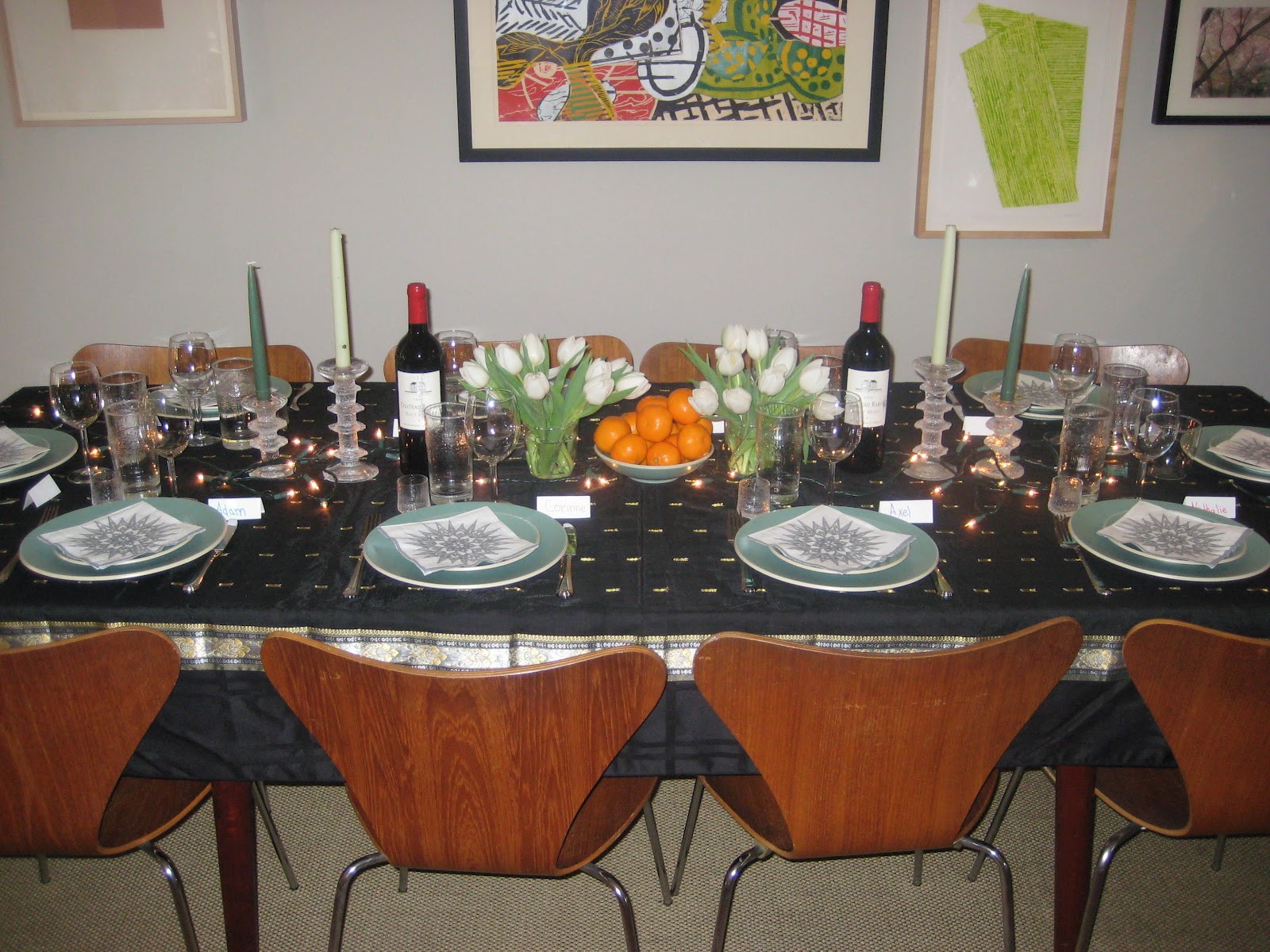
On Christmas Eve, instead of a traditional tablecloth, I used black fabric with gold embroidery that my mother brought back from one of her trips to India. I placed mini Christmas lights around the top of the table along with wine bottles, clementines and white tulips as decoration. There were Vignelli wear plates, which were a wedding gift, and Iitalla candlesticks and glasses from Finland. I also cut down plain white index cards to use as name tags at each place setting.


FOURTH OF JULY

Fourth of July was was super minimal. The dining room table was brought outside and covered in simple white linen. There were white plates from Fish’s Eddyand silverware byDansk. The yellow napkins were bought at Ikea and placed on top of the plates in a diamond shape–rather than folded on the sides–for maximum color effect. The classic bistro glasses were an homage to my French grandparents who drank wine out of glasses just like these every day. I also used them as vases for tiny daisies from my garden placed on either side of the centerpiece.
By the way, if I’d known I was going to blog about these table settings one day, I probably would have made them more elaborate. But there’s a lot to be said for doing things organically and letting them be just as they are.


Monday, June 27, 2011

Genius Jacobs Built-Ins


Recently, I went to California to visit my college roommates and very close friends Matt Jacobsen and Liz Glotzer. They moved to LA right after graduating from Bennington College (there is no way I’m coughing up the year), she went to grad school for film, and he followed with an interest in the history of costumes. Today they are married with two amazing boys and live just east of West Hollywood in the hills. (I hope I got that right–I only asked a million times.)
Jacobsen is the son of renowned architect Hugh Newell Jacobsen and is the proprietor of oldmagazinearticles.com. Glotzer is now a well-known Hollywood executive. She is the daughter of antique dealer Elayne Glotzer, owner of Double Vision in Venice Beach–a charming shop showcasing one of a kind objects and jewelry–and her brother Michael Glotzer is an LA picker with a warehouse full of mid-century furniture.
Together,  my friends designed and decorated their new home with passion and flair. My favorite spot is sitting in front of the Hugh Newell Jacobsen bookcase. Its elegant visual presence draws you into the room. The display is massive, but because the books are shelved in small cubes, boasting strong but minimalist form and color, it invites the viewer to come look, survey the collection, and pick out a book.
These signature built-in bookcases are inspired by wooden antique egg-crates and are designed from floor to ceiling. Perfectly symmetrical, the outer frame, slotted horizontal shelves, and vertical supports are almost paper thin.
A self-proclaimed bibliophile with interests ranging from France, WWI, and England to Art and Architecture, Jacobsen’s need to continually expand his library was, perhaps, the mother of invention when he created his signature “egg crate” bookshelves. Employed in many of his house designs, the innovative shelving is designed like a truss and comprised of 3/8-inch-wall cubes that will allow books to be removed and reinserted in the same or different locations. By removing one cube from the “French” section of the library, for example, one could relocate books about French cuisine to the culinary section of the library and make room for new titles about WWI. This saves completely reorganizing a large collection of books—a task that would be necessary with traditional shelving. The shelving grid also provides a sense of order, while the books themselves create a beautiful, natural wall of color. *
What can I say… Genius!

Monday, June 6, 2011

The Real American Picker


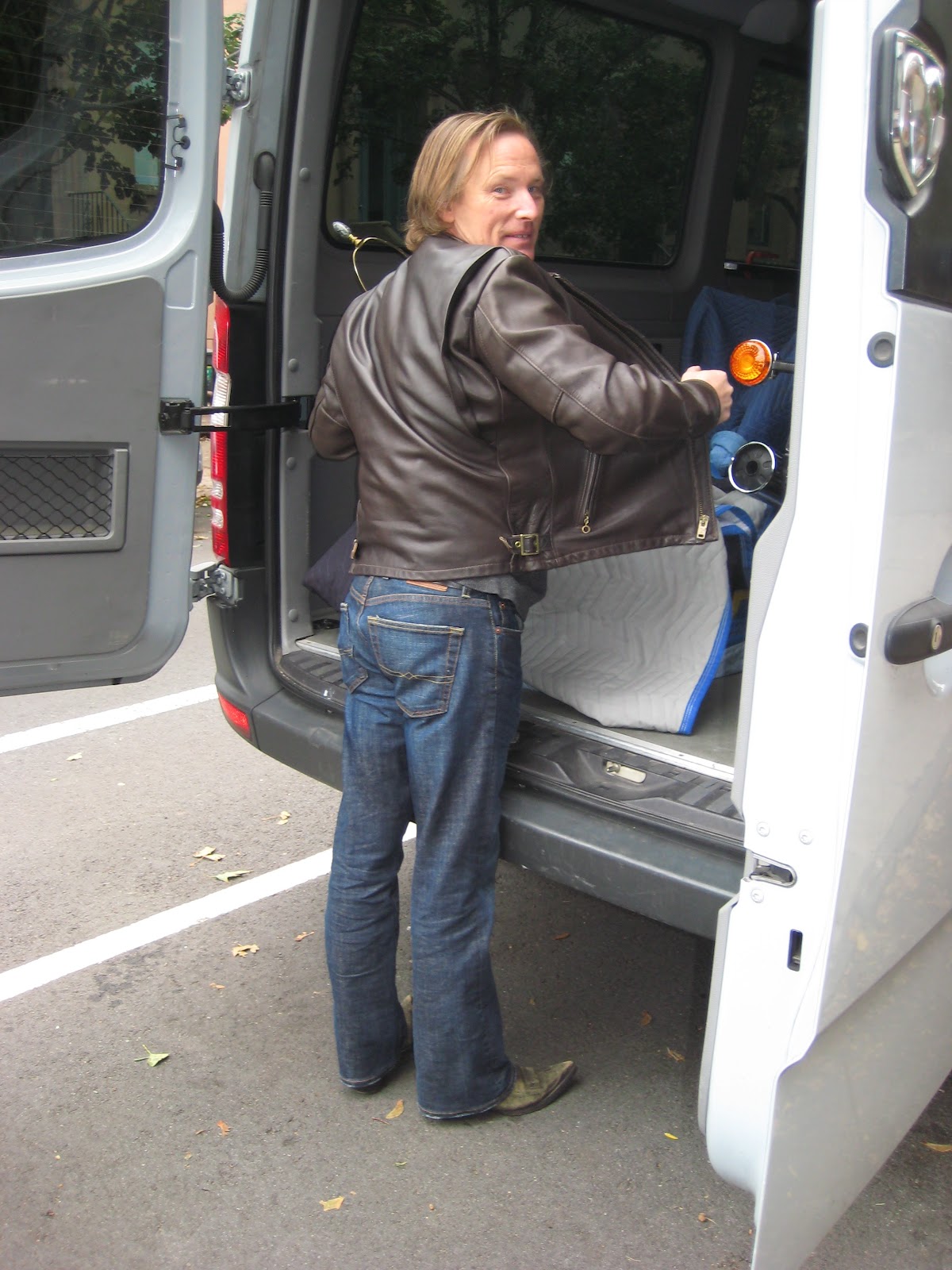
He won’t reveal what he has in the van in this photo, or where he got it, but picker Gary Dias always has the goods.


It was twelve years ago when I first heard about Gary Dias (pronounced DYE-ESS). He was in my store, which was then on Jane Street, inquiring about the best price on a set of three lamps. (Of course, I didn’t know what they were, but they surelooked nice!)
My assistant at the time, George Marshal, said, “Gary Dias was here asking about these lamps.”
“Who’s he?” I asked.
“You don’t know who Gary Dias is?”
I said, “No.”
“He’s one of the best pickers in the business!”
Dias eventually bought the lamps, drove down to Soho and sold them to another dealer within minutes.
Dias now says he would often spend the day buying something from one dealer and driving it across town to sell it to another. But that was in the ’90s when the economy was better and the demand was much higher. Those days are long gone. Today Dias still travels, but often out of state, to find his merch. He is still very connected to most of the downtown modern dealers, as well as a few in Hudson, New York. He works the old fashioned way–always on the road communicating by phone. He never texts or sends pictures. He is only hands-on, bringing the goods straight to your door. 


My most recent (and also favorite) purchase from Dias was a Hans Bellmann popsicle table along with a somewhat rare Robsjohn-Giddings floor lamp, which I rewired and polished. It’s gorgeous! The lamp is available–and reasonably priced–here at my website. Of course, I have no idea where Dias found these great pieces. The picker never shares his secrets.


If you want the sweet deals, contact Gary Dias at gdias@nyc.rr.com.