Monday, June 6, 2011

The Real American Picker


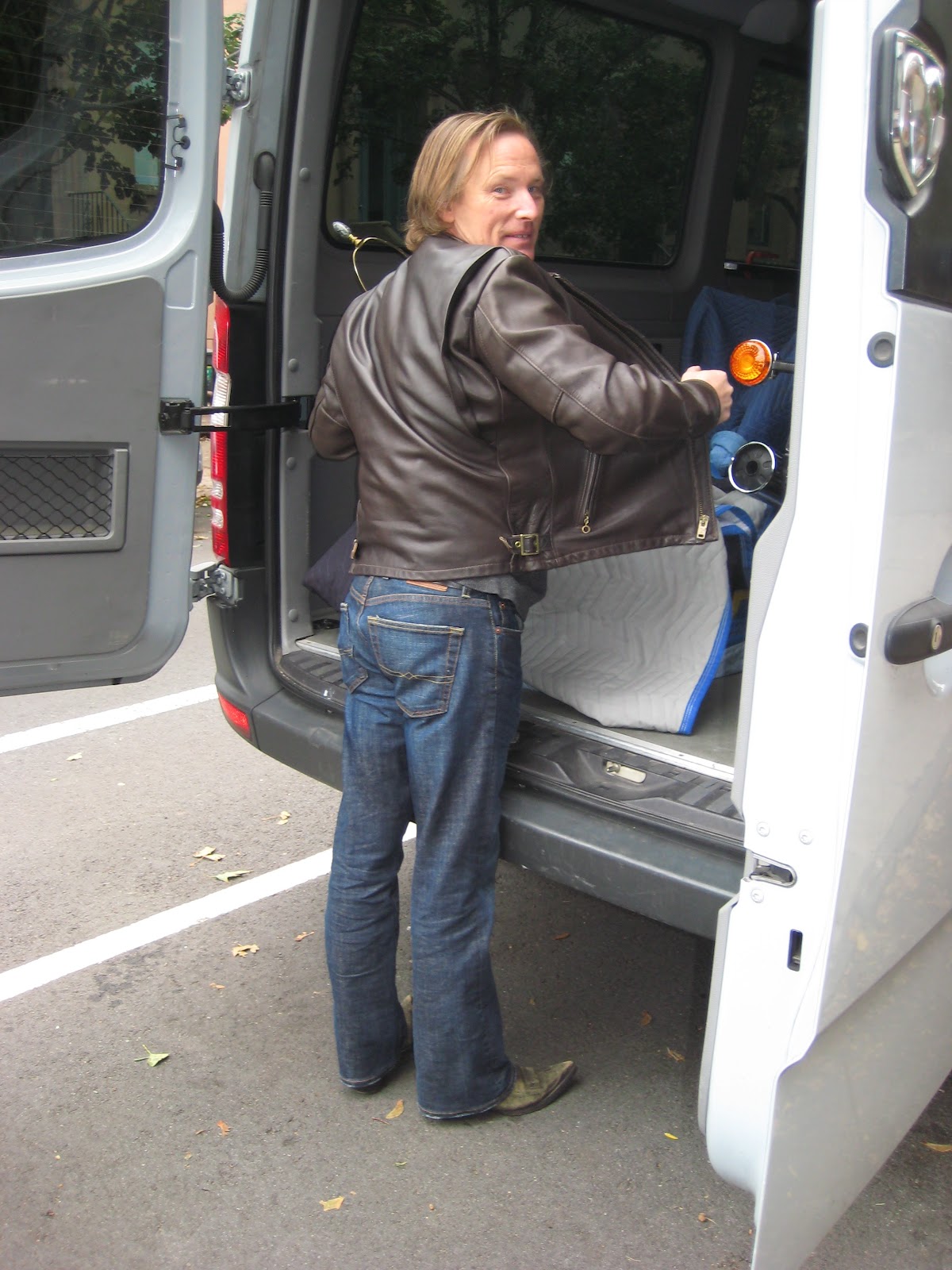
He won’t reveal what he has in the van in this photo, or where he got it, but picker Gary Dias always has the goods.


It was twelve years ago when I first heard about Gary Dias (pronounced DYE-ESS). He was in my store, which was then on Jane Street, inquiring about the best price on a set of three lamps. (Of course, I didn’t know what they were, but they surelooked nice!)
My assistant at the time, George Marshal, said, “Gary Dias was here asking about these lamps.”
“Who’s he?” I asked.
“You don’t know who Gary Dias is?”
I said, “No.”
“He’s one of the best pickers in the business!”
Dias eventually bought the lamps, drove down to Soho and sold them to another dealer within minutes.
Dias now says he would often spend the day buying something from one dealer and driving it across town to sell it to another. But that was in the ’90s when the economy was better and the demand was much higher. Those days are long gone. Today Dias still travels, but often out of state, to find his merch. He is still very connected to most of the downtown modern dealers, as well as a few in Hudson, New York. He works the old fashioned way–always on the road communicating by phone. He never texts or sends pictures. He is only hands-on, bringing the goods straight to your door. 


My most recent (and also favorite) purchase from Dias was a Hans Bellmann popsicle table along with a somewhat rare Robsjohn-Giddings floor lamp, which I rewired and polished. It’s gorgeous! The lamp is available–and reasonably priced–here at my website. Of course, I have no idea where Dias found these great pieces. The picker never shares his secrets.


If you want the sweet deals, contact Gary Dias at gdias@nyc.rr.com.

Thursday, May 5, 2011

Knoll Textiles, 1945-2010, at Bard Graduate Center

From my assistant, Blaise:


In 1943, Florence Schust convinced Hans Knoll that she could turn his furniture company around and on an upswing by  partnering with architects and incorporating interior design into the company’s mission. It worked. They married three years later and together they founded Knoll Associates. When Hans died in a car accident in 1955, Florence took over the business and continued to design. The company flourished under her leadership and acquired designs and commissions from designers such as Hans Bellman, Eero Saarinen, George Nakashima, Harry Bertoia, and Isamu Noguchi.


Florence Knoll was a student of architecture who earned degrees at the Architectural Association in London and the Armour Institute (Illinois Institute of Technology in Chicago). She studied with Ludwig Mies van der Rohe Walter Gropius and Marcel Breuer, among others.
Famous for her “total design” philosophy and space planning and storage innovations, Florence Knoll revolutionized interior design and produced collections that have become 20th century icons that are somehow timeless. She has received the National Medal of Arts and the American Institute of Architects’ Gold Medal for Industrial Design, among numerous other awards.

Knoll’s successful venture into a third division of the company–textile design–has now prompted a new show at the Bard Graduate Center: Decorative Arts, Design History, Material Culture (BGC)Knoll Textiles, 1945–2010, which will run from May 18th through July 31st, is “the first comprehensive exhibition devoted to a leading producer of modern textile design.” The exhibition focuses on Knoll’s leadership and risk-taking practices, the innovation in textile materials, production, and marketing, and the way that the Knoll textile division was ingeniously used to promote that “total design” philosophy.
Find out more about Knoll, Knoll textiles, and the upcoming exhibition at The Bard Graduate Center’s website.


Monday, May 2, 2011

Buying and Selling at the Brooklyn Flea


This spring, I’ve set up shop twice at the famous Brooklyn Flea in Fort Greene. The first time I did it, it rained, so I only got in half a day’s worth of selling. Though that day was cold and dreary, the die hards still came out–people with a good eye, looking to see if I knew my stuff. I was excited to see that people had sophisticated tastes. I sold a few things and then packed up when it started to drizzle. 

Two weeks later I set up again. This time, I could not have asked for more perfect weather. I sold a lot of $15-$20 items, a few $60-$80 items, and two $400 items–an original LCM Eames chair and an action painting by artist D. Aron. It was definitely worth the effort.


The following day I went to the same Brooklyn Flea in Williamsburg (they do Fort Greene on Saturdays and Williamsburg on Sundays), but this time, I was a buyer and not a vendor. I spent money from my flea sales on a vintage Panasonic Tourist for my son Axel, who is leaving for college soon. I’d been looking for the perfect collegiate style bike for several months, and I finally found it. Thanks, Brooklyn Flea!
I’ll be back as a vendor before the summer is over. Stay tuned!
More about the Brooklyn Flea:
Brooklyn Flea operates New York City’s best markets, every weekend of the year, featuring hundreds of top vendors of antique and repurposed furniture, vintage clothing, collectibles and antiques, as well as a tightly curated selection of jewelry, art, and crafts by local artisans and designers, plus delicious fresh food. The New York Times called the Flea “One of the great urban experiences in New York”; Country Living, Budget Travel, and Delta Sky ranked the Flea one of the best markets or antiques shows in the U.S.; andTime Out NY named the Flea one of New York’s Essential Pick-Up Spots.
Since April 2008, Jonathan Butler, founder of Brownstoner.com, Brooklyn’s biggest blog, and Eric Demby, former communications director for Brooklyn Borough President Marty Markowitz, have operated the Brooklyn Flea, a weekly outdoor market in Fort Greene and other “pop-up” locations that features 150 local and regional vendors of antiques, vintage clothing, handmade items, jewelry, food, bicycles, records, and more. In its first three years, the Flea has grown into a New York City institution, garnering local, national, and international press for its diversity of vendors, for the quality of food and merchandise, for the inclusive community aspects of the market’s atmosphere, and for the economic stimulus the market provides to both vendors/entrepreneurs and local businesses.

Monday, February 28, 2011

Freedom Tower


It’s nice to finally see construction of the Freedom Tower and the World Trade Center moving forward. Ever since post-911 I’ve been obsessed with its reconstruction. I often drive to lower Manhattan from Brooklyn via the West Side Highway to sell furniture. Sometimes I take pictures of the site when I’m stopped at a red light. I am amazed at how long it took to even start construction. It’s such a bittersweet feeling when I drive by, I think of all the stories and all the tragedies that occurred. This city is full of wonderful sights, I look forward to having this added to the collection. Anyway, that’s it for now.

Wednesday, February 23, 2011

Mustang or BMW?


His Mustang?...

Last fall I was driving around Columbia County in Upstate New York, and I came across this gas station on Rte. 82 with vintage cars for sale. A client of mine said he was looking for a red Mustang convertible. Boom! There it was. I had suddenly come across someone else’s mid-life wish. Not knowing exactly how serious he was, I thought, is he going to go for it? I took a few pictures for him, but he never followed through. As the old saying goes, you snooze, you lose.
...Or my BMW, bitches?!
Personally, if I came across my vintage dream car, I would have sealed the deal. But my car wouldn’t be a Mustang. It would be a BMW like this sweet 1967 Bavaria!

Monday, February 14, 2011

Warm Your Winter Guests with Freshness and Style (and Booze)

From my assistant, Blaise:


Recently, I invited a few friends over for dinner on what turned out to be one of the most frigid nights of the month thus far. They bundled up and braved the cold, trudging to my place knowing that a free home cooked meal was waiting for them. To help everyone feel nice and toasty I decided to make a special after-dinner apéritif. It’s called a Hot Killer, and it is so easy to make and so delicious. Here’s how:

All you need. Plus a juicer. And some booze.
All you need is a juicer, lemon, fresh ginger, and a bunch of green apples. About 4-5 green apples will fill an 8-10 ounce glass or mug, but don’t hold me to this because I’m really bad at measurements. There were 4 of us and I bought 16 organic green apples and that was enough for one Hot Killer per person.


1. Peel a big hunk of ginger (bigger than what’s shown here, especially if you like a bit more of a warm kick) and cut up all of the apples, leaving them unpeeled.
Slice it all up.

2. Shove the apples and the ginger in the juicer. After everything is juiced, squeeze one whole lemon into the mix.

3. Heat it up on low to medium, stirring occasionally. When it’s boiled it’s basically done…

This looks weird, I know, but trust me.
4.  …Now add a shot of whiskey. (Or two, depending on what you’re going for.) You can also add a drop of natural sweetener like Agave syrup orhoney, or top it off with a few cloves. (In my household, as you can tell from the photo below, we tend to use up the whiskey faster than the honeyor the Agave.) Also, if you want to get fancy and go for a nice presentation, add an apple slice to the side of the glass.


Three optional ingredients. But you'll want something sweet like the agave or the honey. Clearly, we enjoy the bourbon.


With a warm, rich spice and the perfect blend of sweet and tart, Hot Killers are so rejuvenating and perfect for winter, your guests won’t care how they look (did I mention they’re green?) …especially when they’ve had a few rounds.
PS. Clean up’s no fun, but it’s worth it. Maybe in gratitude for your generous hospitality, your guests will do the dishes.


Monday, February 7, 2011

Surf's Up

Last Thursday evening I went to the Faculty Visual Arts Exhibition at The Packer Collegiate Institute from where my firstborn, Axel, is graduating from this June. (So proud.) Two of the faculty members in the show are Axel’s teachers this semester — you guys better give him A’s (just kidding… not really) — and two of them are artists I happen to represent: Mike Miller and Risa Glickman.


Michael Miller


Miller is currently working on a project for the MTA at the Beach 90 Station in Far Rockaway, New York, an area known for its surfing. Five of his gem like paintings have been transformed into faceted glass and will be installed as windows at Beach 90 sometime in the late summer of 2011. Miller’s psychedelic images of surfing and waves is a perfect match for this project, not to mention he is an avid surfer. Go figure!


Glickman is another one of my artists whose landscape drawings have been evolving over the years into a more painterly, looser feel. The introduction of color may have been what freed her. She is looking forward to attending a drawing workshop which she organized next week at Packer.
Ken Rush
I also got a chance to meet and speak with Ken Rush to whom I introduced myself as Axel’s mom. We immediately went to look at his work and I discovered a print that I fell in love with — a beautiful “Solarplate” etching. The process was explained to me but naturally I can’t remember it exactly. It’s basically like intaglio etching without the acid, and with ultraviolet light. (I hope I didn’t butcher that.) Rush said he teaches the process to his students. I wish I could sit in. It sounds so romantic.

If you want to go see this show it’s at The Carol Shen Gallery at Packer Collegiate, 170 Joralemon Street in Brooklyn. The hours are Monday – Friday, 8am – 4pm. The show is up through April 8th.

Wednesday, February 2, 2011

Making it Out Alive: All in a Day's Work

Sometimes I just can’t believe the journey I go on just to get some furniture refinished. I’ve been to several industrial parks in this city before (all business trips, of course) like the ones in East Williamsburg, Greenpoint, Long Island City and somewhere in The Bronx. But these days, about twice a week, I find myself in Sunset Park at the Brooklyn Army Terminal paying a visit to my refinisher and upholsterer.
When I’m driving south down 1st Avenue from 39th Street to 58th Street towards the entrance of the terminal it’s like I’m trapped in a Mad Max movie. No driving rules apply on that 20 block stretch. Not only is the surface of the street a minefield of potholes, train tracks, and cobblestones mixed with black top, but semi’s are always parked along the streets–on the wrong side. Some truck drivers are trying to back up into loading docks with only 2″ clearance. There is usually a sanitation truck convention at all times with vehicles lined up for 3 blocks waiting to take off. As my picker friend Frank Daley would say, “Every time I go down there I lose a year off of my life. It’s a war zone!”
One day when I finally arrived at the gate of the Army Terminal to drop off a Knoll credenza I met a new challenge: a battle with a freight train. Was I really in New York City? Were my other women friends having this same type of encounter getting to work? Was anyone ever going to believe this?
Good thing I had my  trusty camera with me that day. Watch the video. You can’t make this shit up.


Monday, January 31, 2011

My Favorite Living Room


I often find myself sipping white wine and eating shrimp cocktail in the living room of my good friends Susan and Rich Lobel of Brooklyn Heights. It is one of my favorite places. Not only are the Lobels (and their two very charming and talented children) so hospitable but they occupy three stories of a brownstone that was masterfully renovated and designed by architect Brendan Coburn and Joseph Smith of Coburn Architecture in 2005.
Both Susan and Rich have a great eye for furniture and art. One evening when I invited myself over once again–sipping on vodka this time–I discovered a new painting adorning the wall above their piano. I knew it had to be something special. I felt even more excited than when I’ve scored at a flea market or at an auction.
Sure enough, the painting which is plastic and oil on canvas, was an original mid-century piece done in 1959 by Herbert Ferber. Ferber is known for his sculpture but was also a serious painter. His work was part of the early Abstract Expressionist movement in post World War II America and was exhibited alongside the work of de Kooning and Pollock, among others.
The piece was purchased by Susan’s mother (who still goes antiquing at Brimfield every year, you go girl!) from Knoedler Gallery in New York. When Susan’s mom recently moved to a smaller place the painting went to Susan and Rich.
So now my favorite place is even more special. It’s like having your own private museum without paying the price of admission.
PS. They have two of Ferber’s outdoor sculptures on their property in Woodstock, New York. Guess who’s coming to visit this summer!

Monday, January 24, 2011

Modernism in Brooklyn's Public Housing


From my assistant, Blaise:
Ilya Bolotowsky's first study for the Williamsburg houses mural, 1936.
Photo: www.artnet.com
Photo: www.nyc-architecture.com

I’ve walked by this corner several times in Williamsburg. It’s hard not to notice this striking structure — so different from neighboring buildings — but I never knew its significance until Jim Clark, one of the artists represented by Corinne Robbins Art & Design tipped us off on the history.
The term housing project often brings to mind disregarded, depressing, style-less concrete structures that are simultaneously sprawling and confining. But in 1936 William Lescaze, a Swiss-born modernist (who later taught industrial design at Pratt Institute), teamed up with Empire State Building architects and, in collaboration with the Federal Public Works Administration and the newly formed New York City Housing Authority, embarked on creating the Williamsburg Houses. It was the first instance not only of modernism in American low-income housing, but a demonstration of innovation and care devoted to a gravely overlooked and underserved population. The result was a revolutionary 12.8 million dollar design bringing European aesthetics and International Style architecture to Brooklyn and the U.S. at large.
The Williamsburg Houses is a 4-story, 1,622-apartment complex covering 23 acres that transformed 12 extremely bleak slum blocks bordered by Bushwick Avenue and Leonard, Maujer, and Scholes Streets. The buildings which house roughly 6,000 people are angled at 15 degrees to the grid to allow for more sunlight in the homes and breezes through the courtyards. The housing is adorned with tan brick and blue tiles and stainless steel canopies over the doorways, and boasts landscaped parks, playgrounds, commercial storefronts, a community center, and a junior high school. The New Deal-era Federal Art Project also integrated art into the collaboration and commissioned two murals, one by Francis Criss who created a marouflage of the L train, and the other an abstract work by Ilya Bolotowsky.
By the 1960s the Williamsburg Houses were in steady decline. While hailed by many critics, it was also criticized for its shoddy construction and problematic design mechanics. In the mid-1990s extensive revivification began at the behest of NYCHA.
The restoration project was deemed “the best public housing project ever built in New York” where, reportedly, the quality of living has drastically improved. By 1993, the Williamsburg Houses were designated a city landmark.
Historic aerial view. Credit: www.nyc-architecture.com